Can you describe yourself in three words?
Kind, curious and stubborn. And I reckon that the last one does most of the work.
You initially studied medical science before going on to pursue a career in law. What first sparked your interest in science?
Biology, mostly. I loved the molecular end of it: that any biological system is a mess of overlapping, interconnected layers of beauty and complexity.
Growing up, I assumed I’d be a doctor or a lawyer. I tried medicine first. The exams didn’t go well, and I worked out fairly quickly that it wasn’t for me.
My parents never pushed. They wanted me to find work I’d enjoy, and law turned out to be another way into the things I cared about.
You later completed a Master of Laws in Public International Law. What drew you towards international law?
Leuven, Belgium. On my Erasmus year I was picked to represent KU Leuven at Pictet Competition (organised by the Red Cross for universities around the world), a competition on the law of armed conflict. Somewhere in the middle of it I knew this was what I wanted to do.
After that I spent a year at the International Criminal Tribunal for the former Yugoslavia in The Hague, working for the Scottish judge there, Lord Bonomy. I grew up reading Lord of the Rings (well, actually, my father read it to me), and the idea of evil being faceless and distant. In the court room I could see its face, and how afraid it was.
I started thinking seriously about a career at the UN. For that I needed a Master’s, so I came back to study Public International Law at Edinburgh.
The UN didn’t happen in the end, and I don’t regret a day of it. Belgium taught me what it’s like to live inside another country’s way of doing things, and to work with people who see the world from somewhere else. That turns out to be a large part of running clinical trials across borders.
Having had a connection to TauRx from its early days through your dad, Claude, what ultimately led you to pursue your own career with the company?
It was never meant to be a career. My dad asked if I’d come in and help with contracts for six months. Fifteen years later, I’m still here.
It turned out I was useful. And as a lawyer, it can be hard to feel your work makes any difference to anyone. At TauRx I’ve never had to wonder.
You’ve now been part of TauRx for around 15 years. How has your role evolved during that time?
When I joined, we could nearly all fit in one room, never mind one building. Everyone did whatever needed doing.
At different times I looked after IT and HR, until we grew enough to hire people to do those jobs properly. I was quite literally a jack of all trades and a Master of Law.
As the company has grown, I’ve been able to focus on what I’m qualified to do. Today that’s legal, data protection and clinical operations.
Tell us about your current role as Head of Legal, Data Protection and Clinical Operations. What does it involve day-to-day?
It’s hard to describe, because my to-do list is whatever the business needs that week. Morning might be a contract, then a data protection question, then an afternoon could be spent on the consent form for a trial.
Even the parts that feel like box-ticking matter. We’re not making widgets. We work with experimental medicines and with people who have volunteered to take them, so the bar must be high.
For the last year I’ve worked alongside Stephen Harte, who handles most of the corporate and commercial work, while I focus on regulated practice: data protection and Good Clinical Practice.
In-house law can be lonely. Often there’s no one to argue with. Now there is, and the work is better for it.
Your role brings together legal, data protection and clinical operations. How does your scientific background help you navigate those different areas?
I can read a trial protocol and follow the science. Nobody comes to me for scientific advice, and they shouldn’t. But when I’m the one translating between the scientists, the law and the regulators, the gap is a lot narrower.
I also test things hard, my own ideas most of all, and I usually have a plan B, C and D in my back pocket. In this industry there are very few simple problems. There’s almost always one more thing to think about.
You’ve supported clinical trials across several countries and regulatory environments. What have you learned from working internationally?
That you can’t assume what works in one country will work in the next. A consent form that reads clearly in a clinic in Edinburgh can land very differently in Warsaw. The whole point of GDPR was supposed to be that EU countries followed the same rules. If only that were true. There are times it feels like we’re saying: this thing is blue. Germany calls it dark blue, Italy calls it ultramarine, and France might call it cerise.
Every country has its own priorities and habits. You have to learn the ground before you can build on it.
Some of that I learned long before TauRx. I never expected Belgian constitutional law to be any use to me again, but it very clearly explained what the relevant authority was for a trial in Flanders versus Wallonia.
A large part of your work involves translating complex legal and regulatory requirements into practical solutions. What do you enjoy most about that challenge?
We’re not a law firm. Five pages of beautifully argued law won’t help a colleague who needs to get something done by breakfast yesterday. What helps is understanding what they’re trying to do and finding a way to do it that keeps us on the right side of our duties.
Sometimes that means finding a more compliant route. Sometimes it means clearing the way so a team can move faster.
I get to help good people do great things. That’s the best part of the job.
You’ve stepped into areas beyond your legal remit throughout your career. What have those experiences taught you about working across different teams and disciplines?
That an organisational chart is a description, not a fence.
When something goes wrong, you want people around you who will pitch in and fix it, without first checking whether it’s in their job description.
That’s what I value most about TauRx. The people I work with are kind and decent, and they also happen to be very good at what they do.
What has been the main highlight of working at TauRx so far?
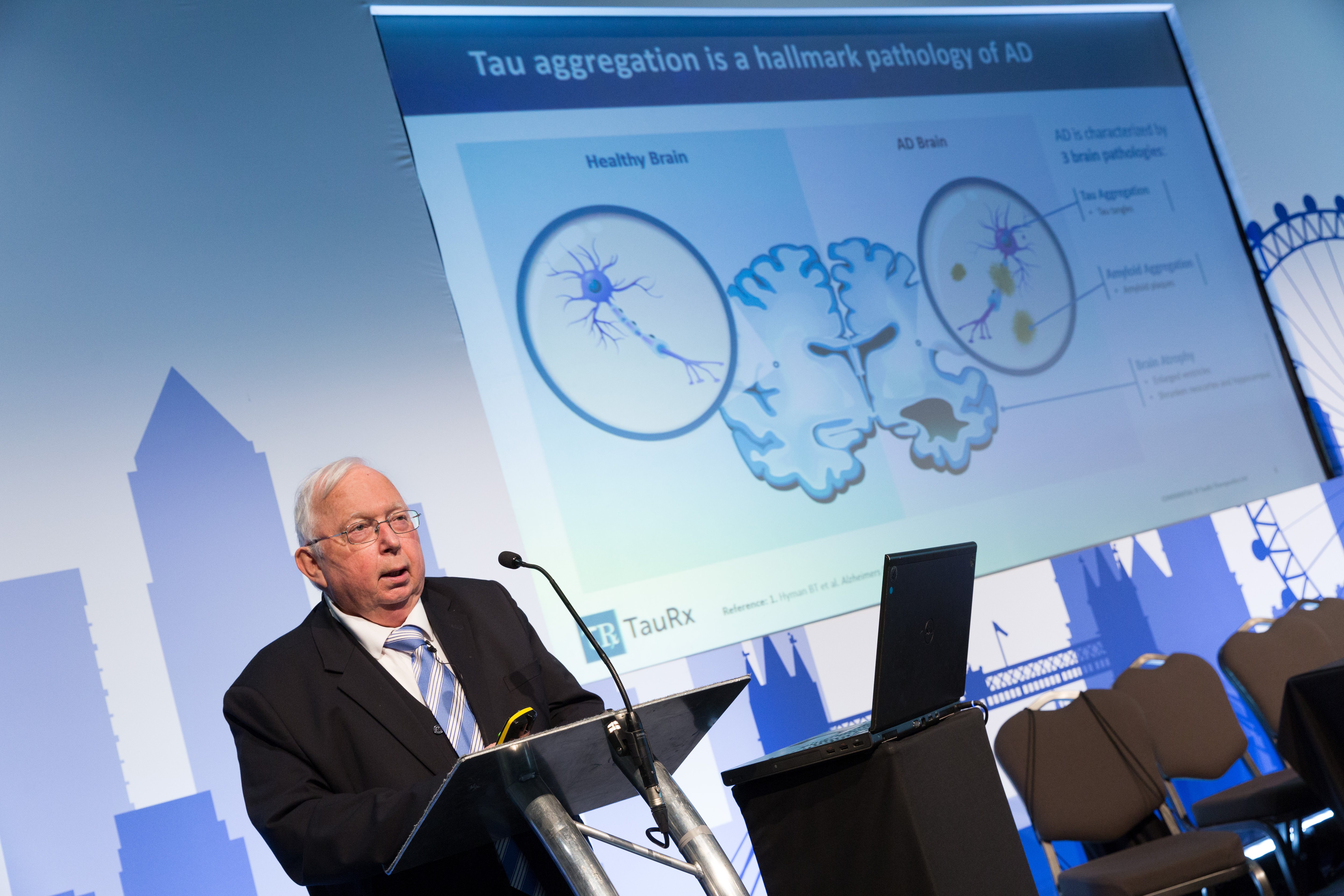
Helping my dad. Alzheimer’s has been dinner-table talk in our family for as long as I can remember. He taught me how to use a spoon. Now I get to help.
What are the top priorities for your role in the year ahead?
Data. It is always, always data. Every scan, every blood sample, every assessment, every clinic visit a trial participant agrees to is a gift of trust.
We owe it to them to learn from it, and to keep it safe.
What is the best professional advice you can give, or that you have been given?
The best advice I was ever given: nobody wants legal advice. They want to know what to do on Monday morning.
So my advice to other in-house lawyers is to get in the trench. Work out what they’re trying to do, then help them do it. Do that, and people start bringing you in early, while you can still shape the answer. Otherwise, they come to you after it’s already gone wrong.
You’ve spoken openly online about being partially sighted. How has that shaped your perspective on your career and the workplace?
I became partially sighted about a decade ago. A lot changed. One thing didn’t: it doesn’t make me a worse lawyer, and I’ve never once felt that anyone at TauRx thought it did. That matters to me.
Carrying a white cane does change the silhouette people see. To some, I’m a “partially sighted lawyer”. At TauRx, I’m a lawyer who happens to be partially sighted.
I don’t have Alzheimer’s, and I wouldn’t claim my experience is anything like that of our patients. But I think the same holds for them. They’re people who happen to have a horrible disease. As an industry, indeed, as a country, I think that sometimes we see the disease more than we see the person.
Law and life sciences are both still short of people who look at things from a different angle. In my case, quite literally.
Tell us something about yourself that would surprise most people
I’m unashamedly a nerd, so after 10 minutes and a cup of tea there probably isn’t much left to surprise anyone.
But I do love wild swimming.
My brother, who lives in Seattle, once challenged me to swim across a lake with him. I wasn’t going to let him do it without me, so I got in. It’s a bit weird and it makes no sense, but I always come out feeling better.
When people see someone who’s partially sighted, they tend to think about limits. Swimming doesn’t need sight.
Sometimes it just needs you to be stubborn enough to keep getting back in the water. And yes, the water off Aberdeen beach isn’t the warmest or the gentlest.
Rough water is also wonderfully focusing. When a 7ft wall of water is about to land on you, there’s no room to worry about anything else. You deal with the next few seconds, and that’s all. I find it oddly restful.
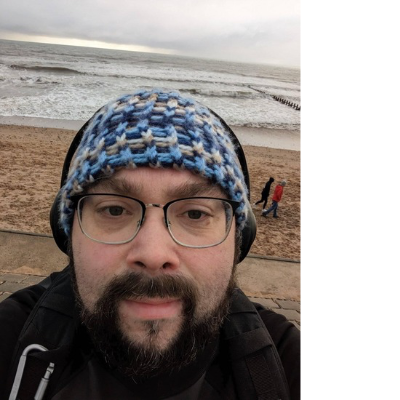
Marcus wild swimming at Aberdeen Beach