Can you describe yourself in three words?
Reliable, resilient and pragmatic.
You started off as an engineer before transitioning into procurement. What led to this change?
Unlike most people here at TauRx, I’m not a doctor or an academic. I started my career as an apprentice engineer, training as a turner fitter where I operated lathes.
I went straight from school into a four-year apprenticeship with Weir Group, a Scottish engineering company based in Glasgow. During that time, I gained a Higher National Diploma (HND) in engineering alongside hands-on experience, working on the tools, operating machinery and assembling equipment, while also learning how the business operated behind the scenes.
As part of my training, I spent three to six months in each office department to build a broader understanding of how the company operated. When I joined the procurement team, they were in the middle of implementing a new system called Oracle. At the time, I was the only computer-literate buyer, with the next youngest member of the team around 30 years older than me, so I quickly became central to the implementation.
There was also a wave of retirements in my first year, which meant I was responsible for converting the hand ledgers to the new system. That experience gave me a strong foundation early in my career, and I’ve stayed in procurement ever since.
How did your career path lead you to your role at TauRx?
I’ve just turned 50, so my career path has been quite varied. After my apprenticeship, I stayed with the same company for a few years, latterly in a procurement management role. I then moved into the furniture industry, which was something I’d always been interested in, as I’d originally wanted to become a furniture maker when I left school. Unfortunately, that company went into liquidation, but furniture-making has since become a hobby – and I went into the healthcare sector, working for a company that ran care homes.
I then decided to start my own business, which I ran for around seven years. We developed an e-procurement platform and provided consultancy support to organisations looking to improve their procurement processes. As a result, a company acquired my client base and I later sold the e-procurement platform to a company in Aberdeen. I worked with them for a year, integrating the system into their operations. That company is now owned by Peterson’s, and the platform is still used by their customers.
After that, I spent around 10 years in the marine sector at a global shipping company called Tidewater, supporting the oil and gas industry. By that point, I was Head of Global Procurement, reporting to the Chief Operating Officer, and I wasn’t looking for anything more senior.
However, while I wasn’t actively looking for another role, I came across the TauRx Head of Procurement position on LinkedIn and decided to go for it.
Procurement is quite transferable. I’ve worked across a number of industries, and while the detail changes, the fundamentals stay the same. You define what’s needed, go to market, negotiate with suppliers and deliver the end result.
When I heard more about what TauRx were doing, it really stood out. TauRx is a smaller company with a lot of potential, and it felt like too good an opportunity to pass up, particularly as it meant being part of something that could genuinely help people.
Tell us about your role as Head of Procurement
My primary responsibility is leading the procurement team, making sure they have what they need to do their jobs properly and supporting their development. I’ve always worked on the basis that if something goes wrong, that’s on me, but if things go well, the credit goes to them.
My job is also to make sure the supply chain performs as well as possible. What a lot of people don’t appreciate is that most organisations are effectively supply chain businesses. Even though TauRx is a pharmaceutical company, we rely on a wide network of external partners and suppliers to deliver what we do, so procurement plays a key role in bringing that all together.
We support all areas of the organisation. On the business side, that includes everything from legal and financial contracts to IT suppliers and even buying stationery. On the operational side, it’s working with technical suppliers and making sure everything is set up and maintained properly and to the highest standards – from contracts and documentation through to ensuring regular reviews are carried out in line with industry expectations.
In the pharmaceutical sector, there are established standards like Good Manufacturing Practice and Good Distribution Practice, but it’s equally important that procurement is carried out in accordance with best practice. That’s something that can sometimes get overlooked, with too much focus on the strict set of rules set out by an industry and overlooking what good procurement practice is. Part of my role is to help TauRx further develop the knowledge of good procurement practice and how to implement it within the organisation and every contract.
There’s also a broader focus on developing the supply chain and making sure we’re a step ahead as it evolves. That includes building on how we work with suppliers to ensure the best outcomes.
Having worked across various sectors, what transferable skills have been most valuable in your move to TauRx?
A key skill in procurement is being able to identify and understand what the organisation actually needs. That might sound simple, but it’s something a lot of people don’t get right.
Good procurement is about stepping back, speaking to multiple stakeholders and vendors then building a view of what’s required.
A lot of that comes down to experience. After working in procurement for many years, you develop a feel for what suppliers are really saying and how to interpret it. It’s not something you can easily teach, it’s something you build over time and through experience.
When I was starting out in procurement, I used to look at more experienced people and think ‘How do they know that?’ I’d sit in on negotiations and think I’d picked it up, but when it came to doing it myself, it was a different story.
One of the key things I’ve learned is knowing when to speak up and defend the company but also recognising when you need to defend your supplier. You’re responsible for protecting the company’s interests, but you also need to make sure you’re not taking advantage of your supply chain. It’s about getting that balance right.
More generally, the ability to keep learning and adapting is essential. You can’t stand still in procurement, things are always changing, and you need to keep moving with them.
What has been the most interesting or rewarding aspect of transitioning from the oil and gas sector to life sciences?
One of the biggest differences is that it’s a completely new industry for me. In previous roles, particularly in engineering and marine, I understood the industries because of my background. Moving into life sciences meant I had to learn about a new industry and while I’ve still got a lot to learn, that’s part of what makes it interesting.
The most rewarding aspect is our potential oral treatment for Alzheimer’s disease and the impact it could have. I’ve seen through family and friends how conditions like dementia affect people, so knowing there’s something that could genuinely make a difference is important. It’s not just about the individuals who have received the diagnosis, it’s about their families and everyone around them as well.
It also changes how you talk about what you do. In previous roles, you’d say you worked in marine or with ships and it was seen as a normal job. Now, when you say you’re part of a company developing a potential treatment for Alzheimer’s disease, people are immediately interested because everyone knows someone who’s been affected.
What has been the main highlight of working at TauRx so far?
It must be the drug – knowing what it has the potential to do and the positive impact it could have on so many people.
What are the top two or three priorities for your role in the year ahead?
The main priority is supporting the potential commercial launch. Procurement is a support function, and we support every part of the organisation, but our focus over the next year is making sure any launches are successful.
That hopefully means supporting launches across multiple countries and ensuring the supply chain is well placed to deliver what’s needed. A big part of that is making sure the drug – should it receive MHRA approval – is available where and when it’s required so that everything runs to the right timelines.
What is the best professional advice you can give, or you have been given?
Be kind. Treat people with respect and don’t let other people’s moods or opinions affect you. Ten seconds of someone else’s negative energy shouldn’t impact your whole day. At the same time, don’t be the person creating that negative energy. Be positive and be kind.
Can you tell us something about yourself that would be a surprise to most people?
I’m a gospel preacher, which tends to surprise most people. It’s something I’ve been doing for many years, going back to my early 20s.
I also enjoy woodwork in my spare time. I have a sawmill where I take fallen trees, mill them into slabs, dry them out and turn them into furniture and other pieces such as chess boards, chopping boards and coffee tables. I’ve also designed and built a saddle rack which I am hoping to commercialise.
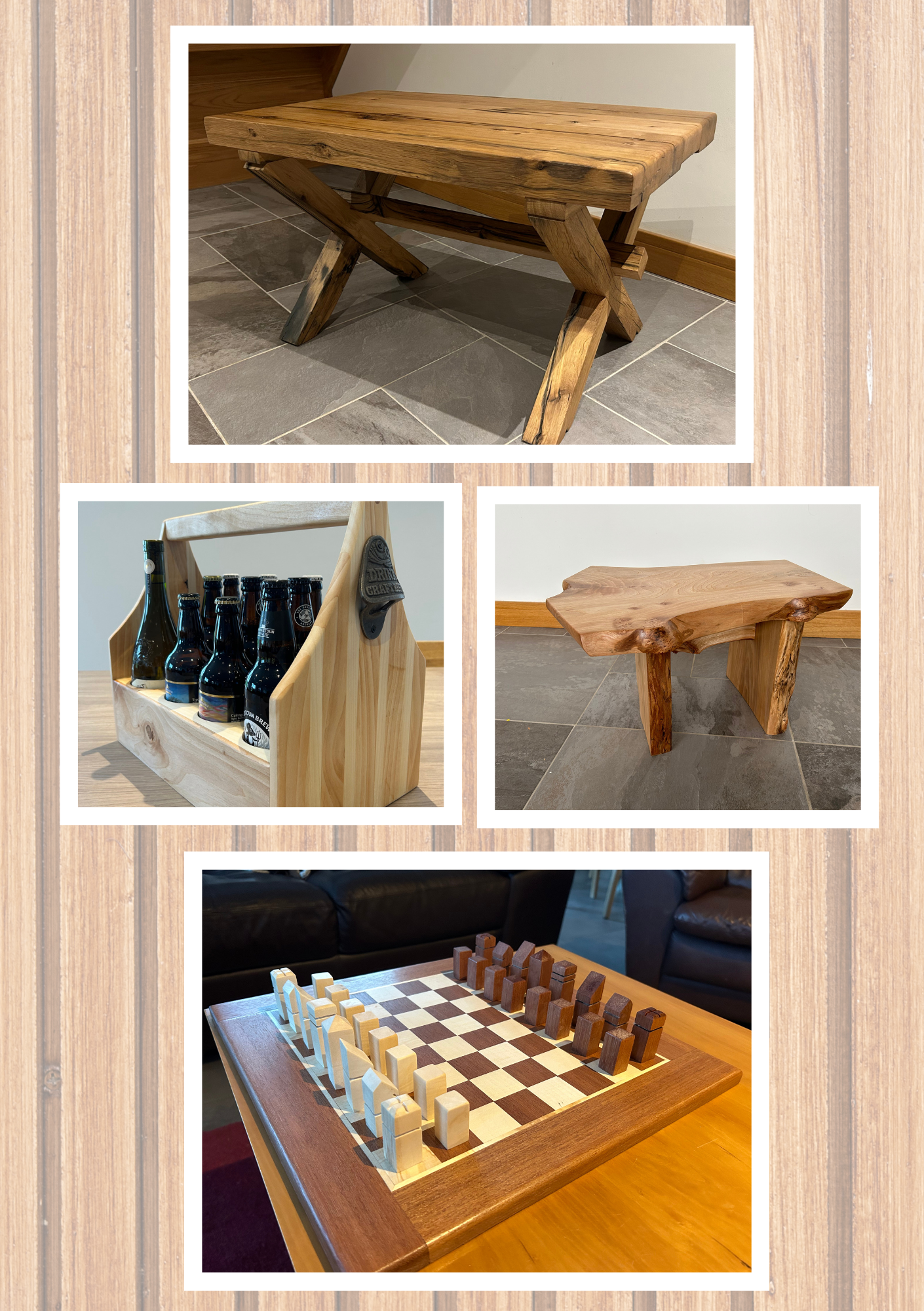
A selection of Derek’s handcrafted furniture and woodworking projects, created from fallen trees he mills and dries himself, as well as a table built from recovered ship deck boards.