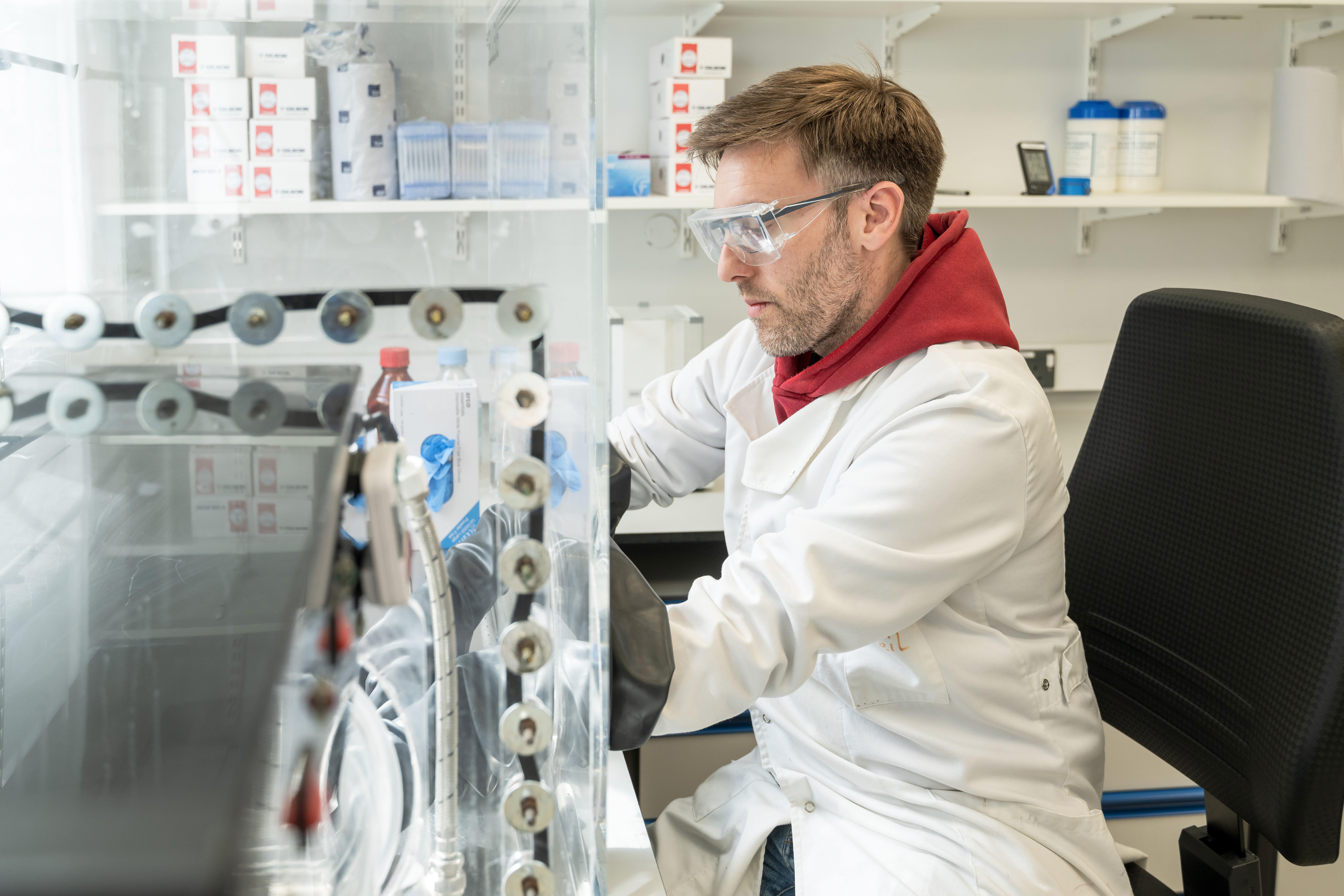
Can you describe yourself in three words?
Inquisitive, loyal and patient.
You went to the University of Aberdeen to study Chemistry. When did you realise this was the path you wanted to take?
I’ve always been interested in science, even from a young age. I naturally gravitated towards it at school and ended up studying physics and chemistry. I started off with physics and biology, but my teachers pushed me towards chemistry.
When I first began thinking about my career, I wanted to be a radiologist. But as I went through school, I realised chemistry was the science I found most interesting, and it was the one I performed best in.
I had an interest in mathematics as well and studied it up to second year at university, so I did have a decision to make about which direction to take. In the end, I chose chemistry as it felt like the right fit.
Looking back, the spark was always there. As a child, I loved watching Tomorrow’s World on TV, a BBC science and technology programme that explored new inventions, ideas and innovations. It really captured my imagination. I’ve always wanted to understand how things work and why things happen, and chemistry gave me a way to explore that curiosity.
What motivated you to pursue your MSc in Cement Chemistry and PhD in Chemistry?
To be honest, I wasn’t entirely sure what I wanted to do. I just knew the oil industry and offshore work weren’t for me, and I wanted to stay in Aberdeen. So doing a master’s felt like the logical next step.
I did some summer work with Professor Fredrik Glasser in cement chemistry, and when I graduated, he had a master’s project available. I already knew him and the area of work, so it made sense to continue.
By the end of my master’s, I knew I wanted to continue in research. Around that time, John Storey, who was my PhD supervisor and is now my boss, had a funding opportunity available. He’d started at roughly the same time, so progressing into a PhD felt like a natural continuation.
How did your career path lead you to your role at TauRx?
I was coming to the end of my PhD when Prof Storey approached me about an opportunity at TauRx and asked if I would be interested in joining the team. It felt like a no brainer, so I jumped at the opportunity.
I started out in research and development, working in analytical chemistry. Day to day, the role involved hands-on lab work, checking instrument calibrations, preparing solutions and getting samples ready for analysis. There was clear overlap with my master’s in terms of analytical techniques and lab skills, so the transition from academia into industry felt straightforward.
Over time, I moved into bioanalysis. The principles are similar, but instead of analysing compounds produced by chemists, the focus is on biological samples from clinical trials. The key difference is that it’s a regulated environment, so all work must follow Good Laboratory Practice and Good Clinical Practice standards, making it much more structured.
Tell us about your role as Senior Study Director and Senior Research Fellow
After several years working at the bench analysing clinical samples, I moved into the role of Study Director in bioanalysis. In a regulated bioanalytical lab, each study requires someone who is ultimately responsible for ensuring the work is carried out properly and in line with regulations, and that’s the Study Director.
It’s more of a project management role than hands-on lab work. I oversee how studies are run, make sure standard operating procedures and study plans are followed, review and approve the data, and take responsibility for preparing the final reports that go back to TauRx to support regulatory submissions.
For context, TauRx originally spun out from research at the University of Aberdeen. Although it’s now a separate company, much of the research and development remains within the university through a long-standing partnership, with our facility effectively running TauRx’s research and development programme as part of that arrangement.
The Senior Research Fellow part of my title reflects my position within the University of Aberdeen. I’m not a lecturer, as I don’t have teaching duties, but I’m part of the university’s research staff.
You have worked at TauRx for almost 20 years. How have you seen technology, the lab environment and the way research is carried out evolve over time?
It’s changed significantly over that time, particularly in terms of automation. The number of samples we can process has probably increased tenfold. Analyses that might have taken 24 hours years ago can now be completed in a matter of hours. Instead of waiting a couple of days to see whether results were good or bad, you can set things up, go home and come back to everything finished.
Digitisation has had an equally big impact. There’s far less paper in the lab now and data capture is fully computerised. If I need to look back at data from 10 years ago, I can pull it up almost instantly. In the past, that would have meant digging through archived paperwork.
We recognised early on that to remain efficient and competitive, we needed to improve how we handled data and processed samples. Around 15 years ago, we began introducing software solutions, first for data handling and then more widely across the lab, and that developed over time.
Regulation has evolved alongside the technology. Requirements are stricter than they used to be and continue to develop, which has changed how studies are run and how carefully everything is documented and reviewed.
It has also meant learning new skills along the way. I’ve had to get to grips with things like programming and database design, which definitely weren’t part of my chemistry degree 25 years ago. I’ve really enjoyed that side of it and the opportunity to keep learning as the lab has evolved.
What has been the main highlight of working at TauRx so far?
For me, it’s the people. I’ve had the chance to work with some great colleagues, a few of whom I’ve known since my PhD, alongside many others who have joined along the way. It’s always been a supportive team environment, and I’ve made some good friends here.
From a professional perspective, I’ve been closely involved in analysing clinical samples throughout my time at TauRx, so seeing the company’s drug receive approval would feel like a significant achievement.
What are the top two or three priorities for your role at TauRx in the year ahead?
TauRx’s focus is moving more towards the synthetic and industrial side of drug production, so I’ve been stepping up to support that. A key priority will be strengthening my knowledge of Good Manufacturing Practice and the analytical techniques that underpin manufacturing.
Alongside that, I’ve taken on more of a management role. Developing my management skills and handling the additional responsibility will be another focus for the year ahead. It’s a natural progression and a new challenge, which keeps things interesting.
What is the best professional advice you can give, or you have been given?
It’s something John Storey once said to me, and it had originally been passed on to him by my master’s supervisor: always say yes to opportunities when they’re presented.
It’s about grabbing every opportunity you get, because it will lead to something. You might not know exactly what at the time, but it will take you somewhere worthwhile.
Tell us something about yourself that would be a surprise to most people
People are often surprised to find out that I’m learning Gaelic. My mum is from North Uist in the Outer Hebrides, where Gaelic was part of her upbringing. I grew up in Aberdeen, so I never really had the chance to learn it when I was younger, but it’s something I’ve wanted to return to.
About a year ago, I joined some free lessons through the University of Aberdeen and now take part in an online class with the Aberdeen Gaelic Club once a week. Many people on the course have Gaelic speakers in their family going back two or three generations, so it’s encouraging to see others taking an interest as well.
I’m still very much a beginner, but I’m starting to recognise words in conversation and feel more confident speaking. It will take time, but even without becoming fluent, it’s still an interesting language and culture to be part of.
Or to put it another way:
Tha mi fhathast gu mòr nam neach-tòiseachaidh, ach tha mi a’ tòiseachadh air faclan aithneachadh ann an còmhradh agus a’ faireachdainn nas misneachaile a’ bruidhinn. Gabhaidh e ùine, ach eadhon gun a bhith fileanta, tha i fhathast na cànan is cultar inntinneach a bhith nam phàirt dheth.